| GBU.IM / THE PERSONAL WEB | HTML 4.0 · RSS |
|
A WORKSHOP ON THE WORLD WIDE WEB Old machines. New possibilities. | UNLEASHED Hardware, software & a little curiosity. EST. 2025 |
| 01 HOME | 02 PROJECTS | 03 JOURNAL | 04 ABOUT |
THE DIRECTORY
Things I build.
Things I figure out.
Notes along the way.
ON THE WORKBENCH
Sisu
A second life for
the Nokia 3210.
SSE-9 / Hardware
DCP-3 / Firmware
FatFloppy
Old disks.
New conversations.
Tour & screenshots
Disks & formats
IN THE JOURNAL
Reverse engineering
Vintage computing
The complete archive
ELSEWHERE
YOU ARE HERE.
A personal corner of the web. Best explored one link at a time.
PROJECT 001 / SISU
SSE-9 hardware
| Overview | Hardware | Firmware | Build |
| Gallery | FAQ | Status | Contact |
On this page: Dimensions | Main devices | Original parts | LTE bands and radio | Power and charging | Known faults | Rev C
The Rev B2 board
SSE-9 replaces the Nokia 3210's mainboard while keeping its display, keypad, audio parts, battery connections and enclosure. Rev B2 is the current prototype; its dimensions, components and known faults are described below.
Design files and build requirements »
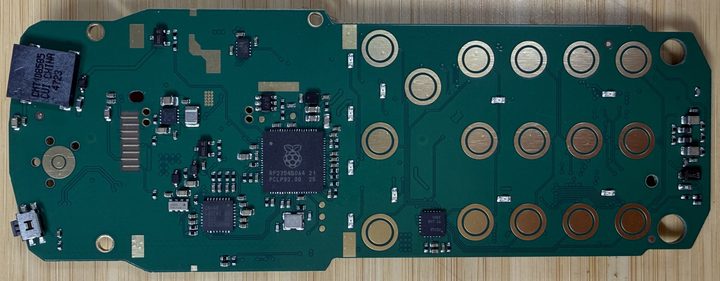
Keypad side of the assembled Rev B2 board.
Dimensions and construction
| ITEM | REV B2 DESIGN | SOURCE |
|---|---|---|
| Outline | 43.87 × 118.22 mm | KiCad edge geometry |
| Stack | 6 copper layers; 1.022 mm nominal | KiCad stack-up |
| Finish | ENIG specified | Fabrication data |
| BOM | 259 visible symbols; 242 populated; 17 DNP | Rev B2 BOM notes |
DNP means deliberately not populated. Check component availability and footprints before ordering parts.
Main devices
| RP2354B | Main microcontroller with 2 MiB stacked flash |
| LE910C1-WWX | Telit cellular module |
| NAU88C22 | Audio codec |
| TCA8418 | Keypad scanner and GPIO expander |
| LTC2959 | Coulomb and power monitor |
| BQ25171-Q1 | Two-cell NiMH charger controller |
| TPS63020 | Buck-boost supply |
| RV-8803-C7 | Real-time clock |
What remains original
The assembled prototype uses the donor phone's enclosure, elastomer keypad and contacts, LCD, earpiece, microphone, buzzer, battery springs, charger jack and headset connector geometry. So far, these have been tested together in one handset; other donor parts and accessories still need checking.
Radio and network
The current prototype uses the Telit LE910C1-WWX, an LTE Cat 1 module with VoLTE and SMS over IMS. Other voice-capable variants in the LE910Cx ThreadX family can be used for different regional band sets. The module is chosen when building the board; changing firmware does not add bands to an existing module.
LTE bands by module
| Module | Region | LTE bands |
|---|---|---|
| LE910C1-WWX Current prototype | Europe, Middle East, Africa, Americas and Asia-Pacific | B1, B2, B3, B4, B5, B7, B8, B8_US, B9, B12, B13, B14, B18, B19, B20, B25, B26, B28 |
| LE910C1-EUX | Europe, Middle East and Africa | B1, B3, B7, B8, B20, B28A |
| LE910C1-SAX | North America | B2, B4, B12, B66 |
| LE910C1-SNX | North America | B2, B4, B5, B12, B13, B66 |
| LE910C1-NFX | North America | B2, B4, B5, B12, B13, B14, B66, B71 |
Source: Telit's LE910Cx ThreadX comparison and June 2026 product brief (PDF). B8_US is Telit's band label.
WWX does not include B66 or B71. The table gives the modules' specified bands; the assembled phone has not been tested across every band. WWX is the only variant used in the prototype so far. A different module may need configuration and antenna adjustments.
Choose a variant with voice support. The SAXD, WWXD, SNXD and NFXD versions are data-only, and Telit does not list voice support for INX.
Antenna and carrier compatibility
DCP-3 includes controls for four antenna-tuner states for the Telit module. Antenna tuning is still being worked on, and band coverage and range need further testing.
Network compatibility depends on local frequency bands, carrier provisioning, IMS/VoLTE support, SIM service and antenna performance. The project has no carrier certification. See Status: network tests for the carrier tested so far.
Power and charging
Rev B2 uses the original two-cell NiMH battery format. The LTC2959 measures charge flow, and the BQ25171-Q1 controls charging with an eight-hour hardware safety timer. DCP-3 supervises the battery and charger; its battery algorithm is described on the firmware page.
Known Rev B2 faults
| ITEM | WHAT NEEDS FIXING |
|---|---|
| USB VBUS backfeed | Rev B2 needs a rework to prevent backfeed. Board 1 has this correction; the fabrication archive does not. |
| Charger enable R77 | A rework is required so the charger can recover a deeply discharged battery without relying on the firmware. Board 1 has this correction; the fabrication archive is unchanged. |
| J2 RF connector | The MHF4L footprint can place one ground terminal on the RF net. This is a board-layout fault, not a firmware issue. |
| Battery spring | The positive spring can rub solder mask above ground copper. Its clearance needs correcting. |
| SIM connector | The SIM supply contact may touch the connector shield. This needs checking and correcting on the next board. |
Rev B2 needs these corrections before it can be reproduced from the fabrication files.
The published errata describe the rework. Before preparing another board, follow the instructions for choosing the current design files.
Rev C
Plans for the next revision are on Status: what's next.
On GitHub: SSE-9 hardware / DCP-3 firmware
Sisu is an independent project, not affiliated with or endorsed by Nokia or HMD. Third-party names, trademarks, and original materials belong to their respective owners. See the hardware notices and firmware notices for credits and terms.
| GEARS & BYTES / Igor Biletski Made for curious people and the computers they keep. | About this site · Back to top ↑ © 2026 · No JavaScript required. |